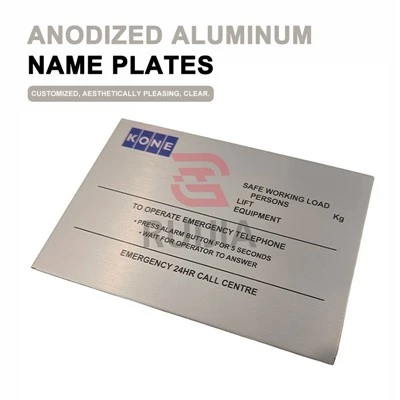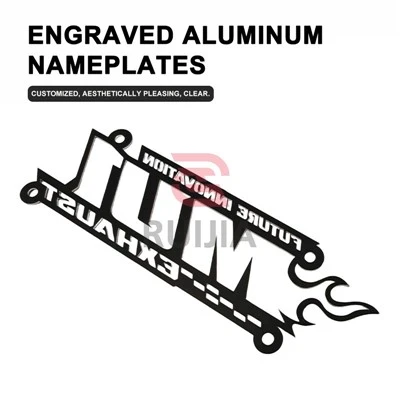


Hangzhou Ruijia Technology Co., Ltd. is one of the most reliable manufacturers and suppliers of 3d embossed brushed silk screen printed aluminium outdoor brand logo in China, also supports customized service. Welcome to wholesale bulk discount 3d embossed brushed silk screen printed aluminium outdoor brand logo for sale here from our factory. If you have any enquiry about free sample, please feel free to email us.
3D Embossed Brushed Silk Screen Printed Aluminium Outdoor Brand Logo
A 3D embossed brushed silk screen printed aluminium outdoor brand logo is a multi-process part, and the specification decisions that determine its field performance are made before the first blank is cut: alloy grade, sheet thickness relative to relief depth, brushed grain direction, ink system, clear-coat type, and mounting method. Ruijia produces this part at its Hangzhou plant on the same 12-node inspection system used across its metal nameplate and badge lines, with embossing, brushing, screen printing, and clear-coat application handled in-house rather than subcontracted across separate workshops.
This page covers the parameters that change cost, tooling, and service life - not a generic description of the category. If your project is already at drawing stage, send the artwork and intended mounting surface; the sampling team returns a physical sample in 3–5 working days.

Processing Specification
| Decision point | What Ruijia needs from you | What it changes |
| Alloy & thickness | Mounting surface, span, relief depth, wind exposure | Rigidity, weight, fastener spacing, cost |
| Relief depth | Desired shadow/standoff effect at viewing distance | Tonnage requirement, tooling cost, minimum sheet thickness |
| Brushed finish | Grain direction and roughness target | Light reflection, ink adhesion, visual consistency |
| Ink system | Indoor/outdoor, cleaning chemicals, UV exposure | Ink chemistry, cure schedule, clear-coat requirement |
| Mounting | Stud, standoff, adhesive, or panel cut-out | Hole pattern, backing structure, installation tolerance |
Embossing, brushing, and printing in one production sequence

Ruijia runs embossing, brushing, and screen printing as linked operations inside a 35,000㎡ plant equipped with 86 automated units, rather than moving partially finished parts between suppliers. That matters for this product because the embossed face is the printing surface: a handling mark or an inconsistent brush grain introduced between embossing and printing cannot be corrected after the ink is cured.
Tooling for embossed aluminium logos is machined in-house. Die clearance and draw radius are set against the alloy and sheet thickness; 5052 requires different clearance from 1052 because it work-hardens during forming. Multi-level relief - where a logo has a raised mark inside a recessed panel - uses a progressive or compound die rather than a single hit, which affects both tooling cost and lead time.


Brushing is performed on the formed part using controlled abrasive rolls. The grain direction is specified on the drawing; on a logo with both flat and raised elements, the brush direction relative to the relief edge is checked on the sample because an unfavourable angle produces a shadow line that reads as a scratch. Printing follows immediately after surface preparation; the screen mesh count is selected against the ink viscosity and the finest line width in the artwork.
Core Products

Aluminium Nameplates

Stainless Steel Name Plates

Brass & Zinc Alloy Badge

QR Code Barcode Asset Tag

Acrylic & Traffolyte Label

Electroformed Nickel Sticker

Wine & Perfume Bottle Label

ABS Car Badge

Metal Phone Stickers
Brushed surface and screen-printed graphics: where adhesion is decided

The brushed finish on this product has two functions: it produces the visible linear grain and it creates a mechanical key for the ink. A brushed surface with too coarse a grain holds ink well but shows through thin ink deposits; too fine a grain improves print resolution but reduces the adhesion anchor. The grain is specified against the ink system and the viewing distance.
Screen printing on brushed aluminium is not a single-pass operation. The surface is degreased and, where required, mechanically keyed before printing. Ink is cured by heat or UV to cross-link the resin; a partially cured ink may pass a visual check and fail adhesion weeks later. At Ruijia, adhesion is checked with the ASTM D3359 cross-hatch test, and screen registration is held to ±0.25 mm on multi-colour work. These are production hold points, not final inspection items.
Ink and clear-coat choices for outdoor service
| System | Outdoor behaviour | When to specify |
| Catalysed epoxy ink | 5–7 years direct UV before top-layer degradation; improved with clear coat | Standard exterior logo, flat or shallow relief |
| Epoxy + UV-resistant clear coat | Service life extended beyond 10 years in many exterior conditions | Coastal, high-UV, or long-specification projects |
| Air-dry enamel | Lower chemical resistance; suitable for sheltered exterior | Budget-driven, short-service-life programmes |
| Laser marking (alternative to ink) | Single colour; no ink adhesion failure mode | Where colour is not required and tactile contrast is acceptable |
The ink is the first component to show age on an outdoor aluminium logo; the aluminium itself does not rust, and an anodised or painted panel will often outlast the printed layer if the ink system and clear coat are mismatched to the exposure. This is why the ink choice is treated as an engineering decision on this product rather than a colour-matching step.
For a 3D embossed brushed silk screen printed aluminium outdoor brand logo, the clear coat must be applied after the ink is fully cured and must be compatible with both the ink chemistry and the brushed surface. A clear coat that beads on the brushed grain or lifts at the relief edge will fail before the ink does.
Quality control production line


Customization and order parameters
The logo artwork, relief depth, overall dimensions, hole positions, and grain direction are produced to a dimensioned drawing. Mounting options include pre-drilled stud or screw holes, concealed standoff fixings, 3M adhesive backing for flat and sheltered surfaces, and clearance holes for direct facade fixing. The mounting method is confirmed before the hole pattern is punched; a standoff fixing and a flush direct mount require different edge distances and, in some cases, different panel thickness.
Small-batch runs and mass production use the same tooling and inspection sequence; the difference is scheduling, not process. The 1,200㎡ sampling centre handles the prototype and pre-production stages, and the 8,000㎡ warehouse supports batch delivery and JIT scheduling for repeat programmes.

Customer reviews

Our factory

Production Base and Workshop Configuration

Production Capacity and Equipment Strength

Quality Control and Compliance System
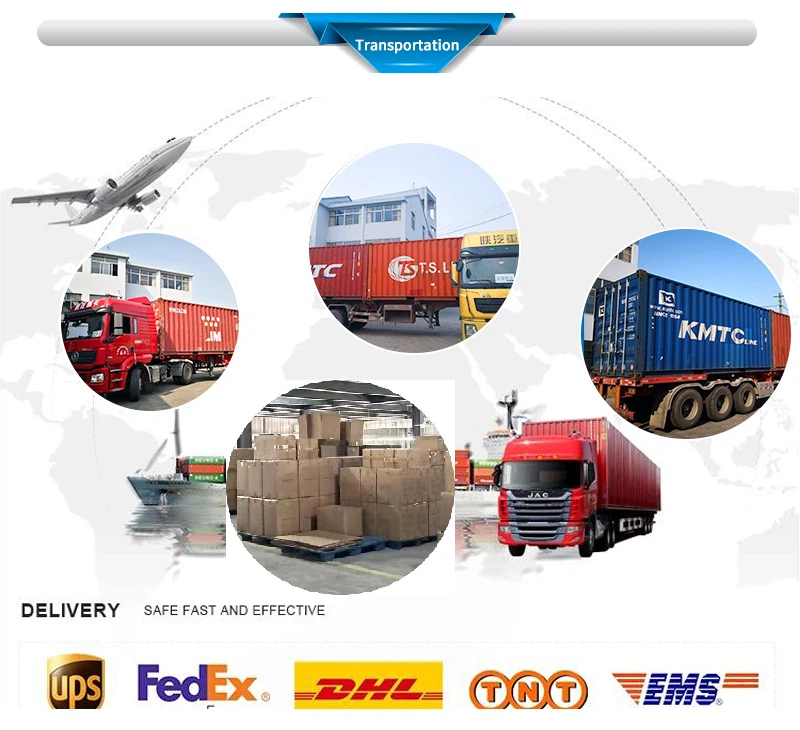
Package & Delivery
Package: Standard export package or Custom
Delivery: By air express, by sea
Exhibition photos


Q: Will screen-printed graphics on a brushed aluminium logo fade or chalk in direct sun?
A: The ink system determines this, not the aluminium. Catalysed epoxy inks typically show top-layer degradation after 5–7 years of direct UV exposure; with a compatible UV-resistant clear coat, the printed layer can remain serviceable well beyond that. For high-UV or coastal projects, specify the epoxy-plus-clear-coat system and request accelerated UV data at quotation stage. Uncoated air-dry enamels are not appropriate for unsheltered exterior use.
Q: How do I specify the relief depth and sheet thickness without over-engineering the part?
A: Start from the viewing distance and the mounting method. A logo read at 1–3 m needs roughly 0.8–1.5 mm of relief to produce a visible shadow; that relief is usually achievable in 1.2–2.0 mm 5052 for exterior use. A logo read at 10 m or more may justify 2–3 mm of relief, which pushes sheet thickness to 2.0–3.0 mm and changes tooling tonnage. Send the installation height and the intended mounting surface, and the relief and thickness can be matched rather than guessed.
Q: The logo will be installed near the coast. Does the alloy grade change?
A: 5052 is the usual starting point for coastal exterior because of its magnesium content and marine corrosion behaviour. The coating system matters as much as the alloy: mill-finish 5052 without a specified clear coat will oxidise at cut edges and around fasteners. For salt-spray exposure, the clear coat and the edge protection at punched holes are specified together, not separately.
Q: Can the embossed face be mounted with adhesive instead of drilled holes?
A: Adhesive mounting is workable on flat, sheltered surfaces where the logo is not exposed to standing water or sustained wind load. On a relief logo, the adhesive contacts the base plane, not the raised elements, so the bond area is reduced relative to the panel footprint. For exterior or large-format parts, mechanical fixing through pre-drilled holes or concealed standoffs is the more predictable option. The mounting method is agreed before the hole pattern is finalised.
Q: How is colour consistency controlled across repeat orders?
A: Ink is matched to a Pantone reference and the screen is produced from the approved artwork. Repeat orders use the retained screen and the same ink formulation, with a retained physical sample as the colour reference. Registration is held to ±0.25 mm on multi-colour work; batch-to-batch variation is checked against the retained sample under the same lighting condition. If the brushed grain changes because the sheet supplier changes, a new colour approval sample is produced before the repeat run.
Contact us for more information.
Hot Tags: 3d embossed brushed silk screen printed aluminium outdoor brand logo, China 3d embossed brushed silk screen printed aluminium outdoor brand logo manufacturers, suppliers, factory