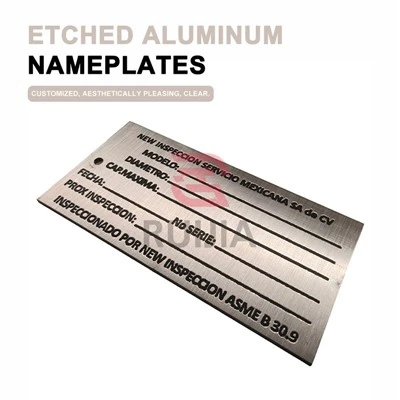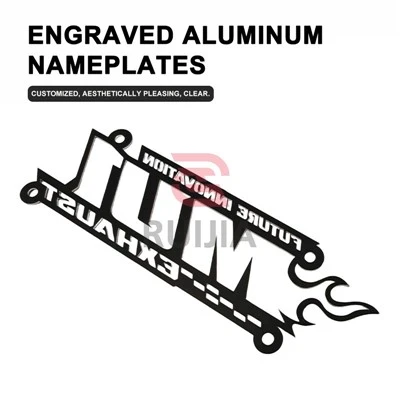


Hangzhou Ruijia Technology Co., Ltd. is one of the most reliable manufacturers and suppliers of vin plate in China, also supports customized service. Welcome to wholesale bulk discount vin plate for sale here from our factory. If you have any enquiry about free sample, please feel free to email us.
3D Embossed Brushed Silk Screen Printed Aluminium Ice Hockey Match Metal Logo
VIN plates are read by inspectors, service technicians, and automated systems. The character edges must remain sharp after stamping, and the plate must not distort around the mounting holes. Aluminium 1050 and 1060 are soft and form clean characters at shallow stamping depths, but they require a coating for engine-bay exposure. 5052 offers better corrosion resistance and work-hardens during stamping, which holds character wall definition better at the same depth. Stainless steel 304 is used where the plate will be exposed to road splash or where the customer specifies a stainless substrate for appearance or durability. The trade-off is higher stamping force and faster tool wear.
Character height is set against the inspection distance and the stamping tool. For 3–5 mm characters, a stamping depth of 0.1–0.2 mm produces a legible impression without thinning the plate at the character base. Depths above 0.3 mm on 0.5 mm aluminium risk cracking at the character corners; the practical limit depends on the alloy and the character geometry. Ruijia confirms character legibility on the physical sample before the die is released for production.

Specification
| Parameter | Range / option | What it determines |
| Material | Aluminium 1050/1060, 5052; stainless steel 304 | Corrosion resistance, weight, stamping behaviour |
| Thickness | 0.5–1.0 mm for aluminium; 0.4–0.8 mm for stainless | Rigidity, stamping depth, rivet pull-through resistance |
| Character height | 3–8 mm typical for VIN plates | Legibility at inspection distance; stamping tool clearance |
| Stamping depth | 0.1–0.3 mm (embossed or debossed) | Tactile readability, paint fill retention |
| Surface finish | Mill finish, anodised, painted, or brushed | Corrosion protection, contrast for character readout |
| Marking method | Stamped characters, laser engraving, or etched fill | Permanence, contrast, tooling cost |
| Mounting | Pre-drilled holes for rivets or screws; adhesive backing on request | Assembly method, tamper resistance |
| Adhesion / paint fill | Paint fill in stamped characters; UV-stable ink where specified | Readability retention under bonnet conditions |
| Corrosion test | ASTM B117 neutral salt spray; 96 h for general engine-bay, 240 h+ for exposed chassis | Coating and base material selection |
| MOQ | 500–1,000 pcs depending on size and tooling | Die amortisation, unit cost |
| Sampling | 5–7 working days after drawing approval | Time to physical approval for fit and legibility |
| Production lead time | 15–25 working days | Replenishment against vehicle build schedules |
Core Products

Aluminium Nameplates

Stainless Steel Name Plates

Brass & Zinc Alloy Badge

QR Code Barcode Asset Tag

Acrylic & Traffolyte Label

Electroformed Nickel Sticker

Wine & Perfume Bottle Label

ABS Car Badge

Metal Phone Stickers
Surface finish and corrosion protection

The finish on a VIN plate has to survive engine-bay heat, oil, brake fluid, and road salt without obscuring the characters. Mill-finish aluminium will oxidise at cut edges and around rivet holes; a conversion coating or anodised layer is specified where the plate is exposed. Anodised aluminium provides a hard, non-conductive surface that resists corrosion, but the anodised layer must be masked at the stamping area if the characters are to be stamped after anodising - stamping through a brittle anodic layer can crack the coating at the character edge.
Paint fill in stamped characters is common on VIN plates because it provides contrast for reading. The paint must be compatible with the stamping depth and the surface finish; a paint that sits proud of the character can be removed by rubbing, and a paint that sits too low loses contrast. UV-stable inks and paints are specified for plates that will see direct sunlight through a windscreen. Salt-spray testing to ASTM B117 is run at 96 hours for general engine-bay exposure and 240 hours or more for chassis-mounted plates, with the test duration agreed against the vehicle manufacturer's specification.
Marking methods and traceability
Stamped characters are the standard for VIN plates because the impression is integral to the metal and cannot be removed without visible rework. Laser engraving is used where a finer character or a data matrix code is required alongside the VIN; the engraved area is typically darker or lighter than the surrounding surface, and the contrast can be enhanced with a fill. Etched fill is used on some plates where the character depth is shallow and the customer requires a coloured fill.
Ruijia's etching lines hold depth tolerance to ±0.005 mm, which matters where the character fill must sit flush with the plate surface. The 12-node inspection system covers incoming material certification, thickness, stamping depth, character legibility, paint fill adhesion, hole position, and corrosion test sampling. The defective rate is held below 3%. For customers requiring traceability, the plate can be supplied with a laser-marked serial number or a data matrix code linked to the production batch.

Mounting and assembly

VIN plates are typically riveted to the vehicle structure, and the rivet holes are positioned to match the customer's fixture. Hole diameter and edge distance are specified on the drawing; a hole placed too close to the plate edge will tear through under rivet pull, and a hole placed too close to a character will distort the character during stamping. Ruijia checks hole position against the drawing on the sample and uses a go/no-go gauge on the production line.
Adhesive-backed VIN plates are available for applications where riveting is not possible, but the adhesive must be specified for the surface energy of the mounting location and the temperature range. Acrylic foam tapes are common for metal-to-metal bonding; the plate surface is cleaned and primed where required. Adhesive mounting is not a substitute for riveting on structural or tamper-evident applications, and the customer's specification governs.
Quality control production line


Order parameters
MOQ is 500–1,000 pcs depending on plate size and whether new tooling is required. The stamping die is quoted as a separate line item on the first order; repeat orders against the retained die do not carry the die charge. Sampling is 5–7 working days after drawing approval, and the sample is where character legibility, stamping depth, finish, and hole position are confirmed together. Bulk production runs 15–25 working days. Ruijia's 8,000㎡ warehouse supports batch delivery and JIT scheduling for customers running vehicle build sequences.
Compliance documentation - RoHS and REACH declarations for the base material, coatings, and inks - is supplied with the shipment. ISO 9001 certification is maintained across the production site. For automotive customers requiring IATF 16949, that certification is not held by Ruijia; buyers should confirm their supplier qualification requirements before placing the order.

Customer reviews

Our factory

Production Base and Workshop Configuration

Production Capacity and Equipment Strength

Quality Control and Compliance System
Package & Delivery
Package: Standard export package or Custom
Delivery: By air express, by sea

Exhibition photos


Q: What material and thickness are typical for a VIN plate?
A: Aluminium 1050 or 5052 at 0.5–0.8 mm is common for engine-bay plates. Stainless steel 304 at 0.4–0.6 mm is specified for chassis-mounted or exposed plates. The thickness is set by the stamping depth and the rivet pull-through requirement; a 0.5 mm aluminium plate with 0.2 mm stamping depth and 4 mm rivet holes is a typical starting point. The final specification is confirmed on the drawing.
Q: How is character legibility verified before production?
A: The sample is inspected under magnification at the agreed character height and stamping depth. Character edge sharpness, fill level, and hole-to-character clearance are checked against the drawing. A first-article inspection report is produced for approval. On production, the 12-node inspection system includes a character legibility check at the start of each batch and at defined intervals.
Q: What corrosion test duration applies to a VIN plate?
A: ASTM B117 neutral salt spray is run at 96 hours for general engine-bay exposure. For plates mounted on the chassis or exposed to road splash, 240 hours or more is specified, depending on the vehicle manufacturer's requirement. The test duration is agreed at quotation; the report is supplied with the batch where specified.
Q: What is the MOQ and lead time for a first order versus a repeat?
A: MOQ is 500–1,000 pcs depending on size and tooling. First order: sampling 5–7 working days after drawing approval, then bulk production 15–25 working days. The stamping die is a separate line item. Repeat orders against the retained die skip the die charge and can be scheduled against the customer's delivery sequence.
Q: Does Ruijia hold IATF 16949 for automotive VIN plates?
A: Ruijia maintains ISO 9001 certification. IATF 16949 is not held. Automotive buyers should confirm their supplier qualification requirements before ordering; where IATF 16949 is mandatory, Ruijia is not a qualified source. RoHS and REACH documentation for the materials and coatings is available with the shipment.
Contact us for more information.
Hot Tags: vin plate, China vin plate manufacturers, suppliers, factory