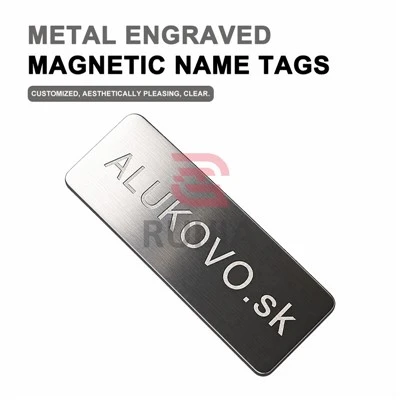


Hangzhou Ruijia Technology Co., Ltd. is one of the most reliable manufacturers and suppliers of elevator car station braille plates in China, also supports customized service. Welcome to wholesale bulk discount elevator car station braille plates for sale here from our factory. If you have any enquiry about free sample, please feel free to email us.
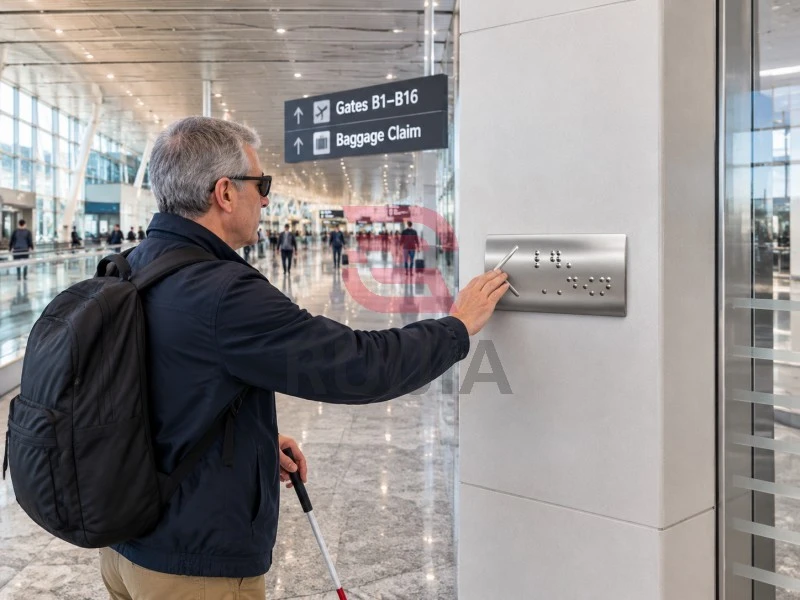
Stainless Steel Braille Elevator Sign Brushed Tactile Plate with Raised Dots and Directional Arrow for Accessibility
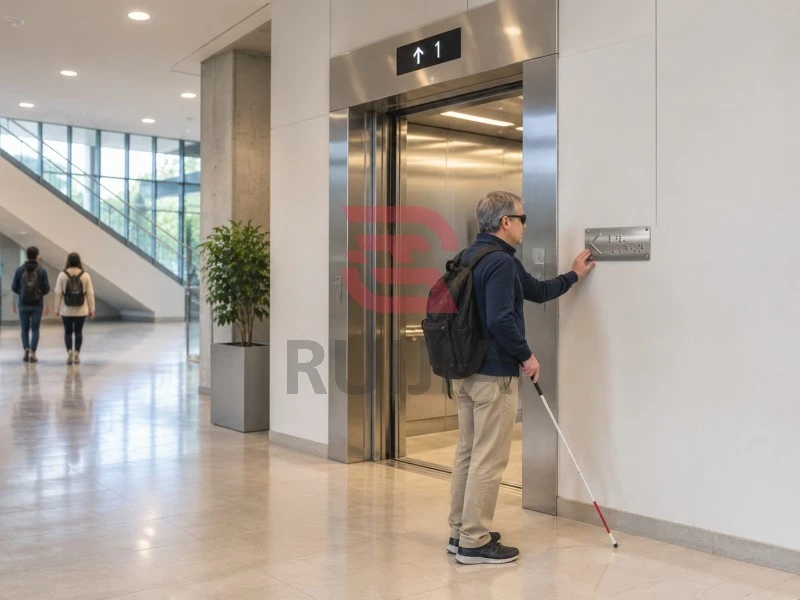
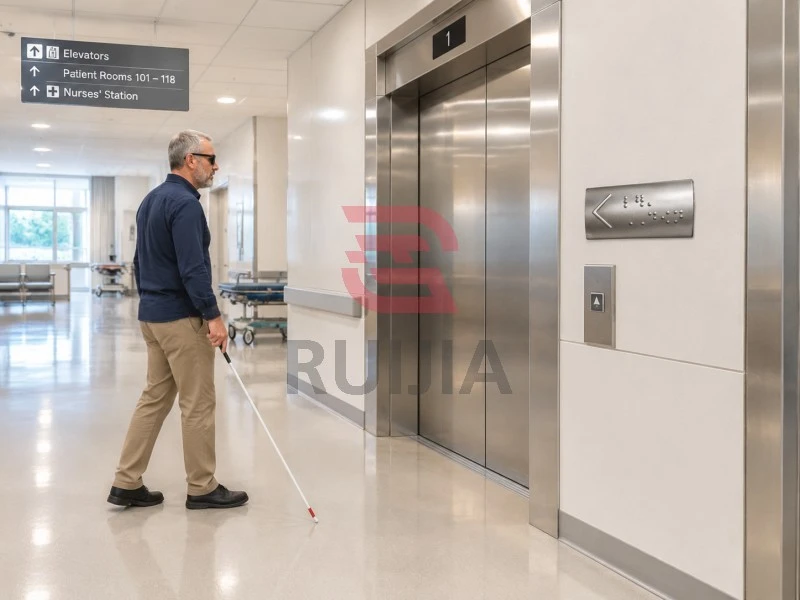
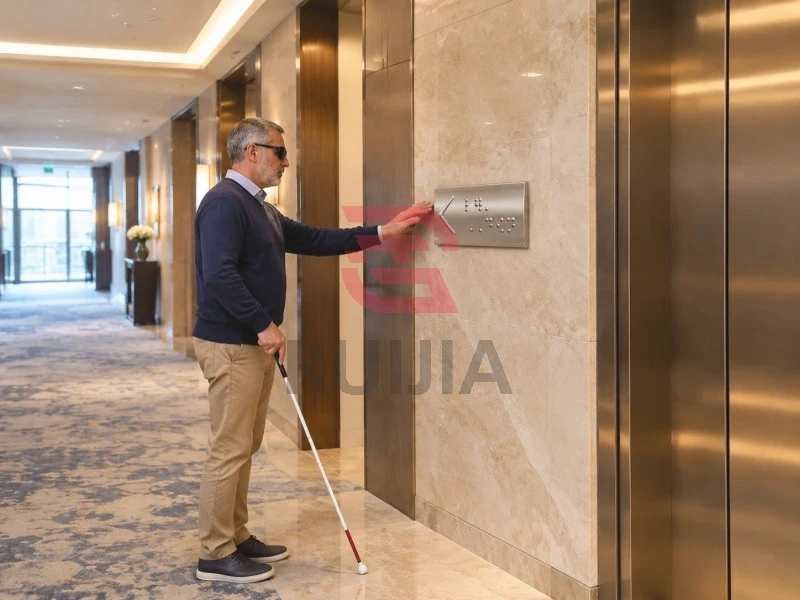
Material and Plate Construction
The plate body is formed from 304 or 316 stainless steel, depending on the installation environment. For standard indoor elevator car stations, 304 provides sufficient corrosion resistance at a lower material cost; for coastal, high-humidity, or frequent-cleaning applications, 316 is specified for its molybdenum content and resistance to chloride-induced surface degradation. Plate thickness is quoted against the elevator panel or jamb substrate it will be mounted to - common production runs sit between 0.9 mm and 1.6 mm, with thicker 19-gauge (approximately 1.0 mm) stock available for high-traffic installations where resistance to deformation matters more than weight. Exact thickness for your project is confirmed at drawing approval; non-standard thicknesses outside our standard range require a tooling review before quotation.
The brushed finish is applied to the face before the tactile elements are formed, so the grain direction remains continuous across the plate and is not interrupted by raised characters or Braille dots. Raised elements are produced through chemical etching or embossing, both of which keep the Braille dots integral to the plate body rather than applied as surface attachments. Dot height is held within the 4–5 mm range referenced in ISO 23599 for tactile elements that need to be detectable without presenting a trip or snag hazard on the panel surface.
Specifications
| Item | Specification |
| Material / Thickness | Stainless steel; 0.3–1.5 mm (customizable). Specific grade:Detailed data, please consult us. |
| Size / Shape | Custom size per artwork/sample; round, square, rectangular, oval or irregular shape |
| Forming / Surface | Stamping, etching, engraving, cutting, embossing; brushing, polishing, sandblasting, plating, powder coating, anodizing |
| Tactile Elements | Raised Braille dots and directional arrow. Braille grade, dot height, dot diameter and spacing:Detailed data, please consult us. |
| Color / Marking | Silver, gold, black, blue, red, bronze, nickel, chrome, Pantone/CMYK; silk screen, pad printing, laser engraving, digital/offset printing |
| Installation | Self-adhesive, screw, rivet, magnetic or buckle fixing. Adhesive/fastener selection for specific elevator panel:Detailed data, please consult us. |
| Customization | OEM/ODM; custom material, size, logo, color and process; free artwork optimization; AI, CDR, PDF, PSD, JPG, PNG accepted |
| MOQ / Sampling | 100–500 pcs/sets/㎡; samples in 3–5 working days after design confirmation |
| Batch Lead Time | 15–30 working days, depending on quantity, complexity and customization |
| Quality / Certification | 12 inspection nodes; defective rate within 3%; RoHS, REACH, EPR, IEC, ISO 9001 |
| Capacity / Logistics | 35,000㎡ production base; 86 automated equipment; 8,000㎡ warehouse; delivery to major global ports 7–45 days. Product-specific capacity/packaging:Detailed data, please consult us. |
Tactile and Visual Specifications

Braille is contracted Grade 2, positioned below or adjacent to the corresponding raised character or floor designation. On elevator car station plates, the separation between Braille and the associated raised text or symbol is held to a minimum of 4.8 mm (3/16 inch), the reduced spacing permitted for elevator control applications under ADA 703.3.2; clearance to raised borders and decorative elements remains at 9.5 mm (3/8 inch) minimum. Raised characters are produced to a minimum 1/32 inch (0.8 mm) relief height, with character stroke and width proportions verified against the approved artwork before etching.
The directional arrow is formed as a raised tactile element at the same relief height as the Braille and characters, so the arrow is legible by touch along the same plane as the floor designation. Contrast between the brushed field and the etched or filled characters is specified at artwork stage - options include black-filled characters on brushed stainless, or a dark base coat with brushed stainless characters. Luminance contrast is measured on the approved sample; if your project specifies a contrast ratio under a particular accessibility code, that value is confirmed against the sample rather than assumed from the material combination.
Compliance Reference Points
Elevator car station plates fall under the tactile signage provisions of ADA 703 and, where applicable, ISO 23599 / ISO 24183 for tactile lettering and Braille presentation. Plates are produced with Grade 2 Braille and raised characters, and the Braille-to-character spacing follows the elevator-specific exception in ADA 703.3.2 rather than the general 9.5 mm rule that applies to room and wayfinding signs. For projects requiring ANSI A117.1 alignment, the same spacing and relief parameters are cross-checked against that standard at drawing approval.
Material and coating compliance is supported by our existing certification set: RoHS, REACH, EPR, and IEC, under an ISO 9001 quality system. Stainless steel grades are sourced with mill certificates traceable to the heat number, and coating or fill materials used on the plate are reviewed against the restricted-substance thresholds relevant to the destination market. If your project requires a declaration not covered by the standard document package, that is raised during quotation rather than after production.
Core Products

Aluminium Nameplates

Stainless Steel Name Plates

Brass & Zinc Alloy Badge

QR Code Barcode Asset Tag

Acrylic & Traffolyte Label

Electroformed Nickel Sticker

Wine & Perfume Bottle Label

ABS Car Badge

Metal Phone Stickers
Quality control production line


Customization and Order Parameters
Floor designations, directional arrows, and Braille content are produced to your schedule - standard elevator car plates cover floor numbers and common directional symbols, while custom arrow configurations, bilingual character sets, and non-standard plate outlines are quoted against the drawing. Artwork is accepted in AI, CDR, PDF, or DXF; Braille translation is verified against the submitted text before etching, and a digital proof showing dot placement and character spacing is returned for approval.
Sampling runs 3–5 working days from approved artwork, with physical samples including the specified stainless grade, finish, and fill color. MOQ for custom elevator Braille plates typically falls within 100–500 pieces per configuration, depending on plate size and whether a new etch tool is required; existing tooling configurations start at the lower end of that range. Batch production is quoted at 15–30 working days after sample approval, and the production schedule is confirmed against the plate count and the number of unique floor/arrow configurations in the order. Detailed capacity and scheduling data for your specific configuration is available on request.

Customer reviews

Our factory

Production Base and Workshop Configuration

Production Capacity and Equipment Strength

Quality Control and Compliance System
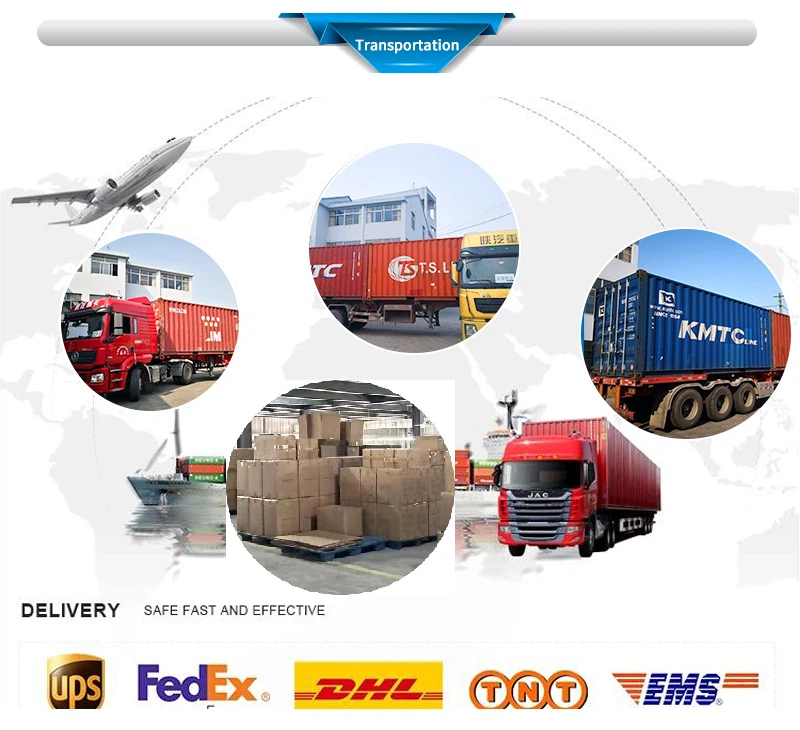
Package & Delivery
Package: Standard export package or Custom
Delivery: By air express, by sea
Exhibition photos


FAQ
Q: How is Braille spacing verified on elevator car plates against the 9.5 mm general rule?
A: Elevator car control plates use the ADA 703.3.2 exception: Braille is held to a minimum 4.8 mm (3/16 inch) from the corresponding raised character or symbol, rather than the 9.5 mm (3/8 inch) separation applied to room signs and wayfinding signage. Clearance to raised borders and decorative elements remains at 9.5 mm. The spacing is set in the artwork file and measured on the approval sample before the production run begins.
Q: Can the plate be supplied in 316 stainless for coastal or high-cleaning elevator installations?
A: Yes. 316 is quoted as an alternative to 304 when the elevator is exposed to salt-laden air, frequent chlorine-based cleaning, or condensing humidity. The mill certificate for the selected grade is included in the document package. Surface finish and Braille formation parameters are adjusted for 316 because its etching response differs slightly from 304; the approval sample is produced in the final specified grade, not in 304 as a stand-in.
Q: What is the typical MOQ and sampling timeline for a custom floor configuration?
A: Custom floor/arrow configurations generally start at 100–500 pieces per configuration, depending on plate size and whether a new etch tool is required. Sampling is 3–5 working days from approved artwork, and the sample is produced in the specified stainless grade and finish. Batch lead time is 15–30 working days after sample approval. Orders with multiple unique floor plates are scheduled by configuration count, not only total piece count.
Q: How is the plate mounted if the elevator panel cannot be drilled?
A: Full-coverage acrylic foam tape is the standard adhesive option for panels where drilling is not permitted or not practical. The installation sheet specifies minimum surface temperature, cleaning method, and dwell time before the elevator is returned to service. For panels with textured or low-surface-energy coatings, an adhesion promoter is quoted separately after review of the panel substrate. Mechanical fixing through pre-drilled holes remains available where the panel construction allows fasteners.
Contact us for more information.
Hot Tags: elevator car station braille plates, China elevator car station braille plates manufacturers, suppliers, factory