Among the diverse forms of everyday objects, the safety pin, with its simple form, carries functional wisdom and cultural connotations that transcend time and space. As a basic fastener formed by bending metal wire, it may seem ordinary, but its ingenious structural design and versatility in application scenarios make it a unique medium connecting practical needs and creative expression.
Functionally, the core value of the safety pin lies in "fixation" and "connection." Its prototype can be traced back to ancient times, when early humans used animal bones and thorns to pierce fabric for simple fixation. With the maturity of metalworking, the application of elastic metal wire gave the safety pin its modern form-openable and resilient. The standard safety pin, through its needle-point piercing and spring-loaded spring mechanism, can firmly hold various materials such as paper and fabric, while avoiding the damage to the material caused by traditional sewing. This "non-destructive fixing" characteristic has long held an irreplaceable position in office work, handicrafts, and clothing organization.
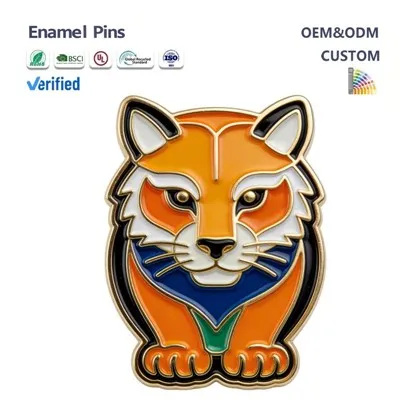
As needs evolve, the form and function of the safety pin continue to expand. Beyond basic straight safety pins, safety pins, with their closed-loop design, eliminate the risk of sharp edges, making them suitable for children's products and medical settings; decorative pins incorporate enamel and openwork techniques, becoming miniature works of art that adorn clothing and serve as identifiers; industrial pins, with their enhanced load-bearing capacity, serve professional fields such as textiles and packaging. This evolution from a "tool" to a "tool + symbol" reflects humanity's dual pursuit of both the "practicality" and "aesthetics" of objects.
In the contemporary context, the significance of safety pins transcends their physical function. They are a miniature medium of the creative economy-craft bloggers use safety pins to connect materials to create installation art, and environmentalists use them to replace disposable fasteners and promote sustainable living; they are also anchors of cultural memory, with old photographs showing receipts and documents secured by safety pins, subtly revealing the connection between individuals and their era. Even in the digital age, the organization of physical documents and the transmission of the warmth of handmade crafts still rely on this small object, confirming the design philosophy that "simplicity is timelessness."
A single safety pin, within its small space, encapsulates the ingenuity of materials science, the wisdom of functionalism, and humanity's insight into the beauty of the smallest details. It is not only a practical tool, but also a microscopic window into how everyday objects participate in the process of civilization-when we pluck that arc of metal between our fingers, we are touching the creative genes and wisdom of life that span thousands of years.