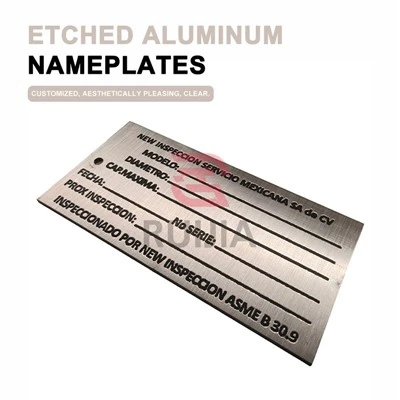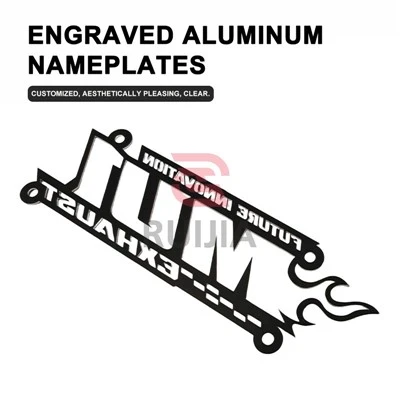


Hangzhou Ruijia Technology Co., Ltd. is one of the most reliable manufacturers and suppliers of aluminum door plate in China, also supports customized service. Welcome to wholesale bulk discount aluminum door plate for sale here from our factory. If you have any enquiry about free sample, please feel free to email us.
Custom Sandblasted Aluminum Furniture Door Logo Plate
A furniture door logo plate carries two jobs at once: it identifies the brand on the face of a door, and it has to sit flat against that door for years without lifting at the edges, dulling unevenly, or reading as a different shade from the batch delivered six months earlier. The sandblasted anodized surface is chosen for the second job. Blasting before anodizing produces a uniform matte that diffuses light rather than reflecting it, so the plate reads as a subdued branded element on gloss lacquer, veneer, or matte film faces without competing with the furniture finish.
Our standard construction uses 6061 aluminum in 0.8 mm to 3.0 mm, with 6063 available where the buyer needs a smoother base for color consistency across larger visible faces. Thickness is selected against the mounting method and the door-face condition, not as a fixed catalogue value. A plate bonded to a flat lacquered MDF face behaves differently from one riveted to a curved veneered edge, and the back profile is machined or formed to match the intended surface before the sandblast step.

Specification
The finish is defined by two parameters that can be written into a purchase order and verified on the sample: surface roughness and anodic film thickness.
| Parameter | Standard range | Verification reference |
| Surface roughness after blasting | Ra 1.6–3.2 μm | Stylus profilometer, per batch |
| Anodizing thickness | 10–20 μm, ISO 7599AA 10 / AA 15available | Eddy-current gauge, ASTM B244 |
| Grit size | #80–#150, specified per visual target | Supplier certificate retained |
| Blasting pressure | 0.2–0.6 MPa, adjusted to alloy and thickness | Process parameter sheet per order |
| Color consistency | ΔE ≤ 1.5 against approved master, same anodizing bath lot | Spectrophotometer, D65 |
Blasting at the lower end of the Ra range (1.6–2.0 μm) gives a finer matte that suits small type and fine rules; the upper end (2.5–3.2 μm) produces a coarser, more tactile surface that holds up better against handling marks on larger door faces. The anodic film is sealed after coloring, so the surface does not absorb oils from handling during furniture assembly. ISO 7599 AA 10 means a minimum average film of 10 μm with a minimum local thickness of 8 μm; AA 15 raises the minimum local figure to 12 μm and is specified where the plate will be cleaned with alkaline or mildly acidic agents.
Core Products

Aluminium Nameplates

Stainless Steel Name Plates

Brass & Zinc Alloy Badge

QR Code Barcode Asset Tag

Acrylic & Traffolyte Label

Electroformed Nickel Sticker

Wine & Perfume Bottle Label

ABS Car Badge

Metal Phone Stickers
Wholesale packaging and line-side presentation

Logo plates are small, visible, and easy to scratch before they reach the assembly station. Packaging is specified as a line-side control, not as a shipping afterthought.
Glassine interleaving is standard between plates in a stack. Glassine is non-abrasive and does not transfer plasticizer, so the anodized face stays free of handling scuffs during transit and unpacking. Plates can be supplied in individual glassine sleeves with a printed ruler edge, which lets the furniture line verify the plate length against the door prep without opening every sleeve - a practical check on mixed-size orders.
For wholesale buyers distributing to multiple furniture factories, plates are packed in barcode-labelled inner bags by SKU and color batch, so a receiving warehouse can book the goods against the purchase order without opening sealed inner packs. Master cartons are sized to a half-Euro or full-Euro footprint on request, and carton drop-test reports are available for buyers who consolidate into their own export containers.
Packaging specification is written into the quotation as a line item. Buyers who leave it unspecified usually discover at the first reorder that the packaging cost was either absorbed into an opaque unit price or substituted with a lower-protection format.

What is controlled at the production line

Every order is preceded by a pre-production sample approved against the buyer's drawing and a physical surface master. The approved sample is retained at the line for the duration of the order and for any repeat order against the same SKU.
The QC sequence for a custom sandblasted aluminum furniture door logo plate covers: incoming alloy certificate and thickness check → blanking and hole-position measurement → blast roughness spot check → anodic film thickness reading → color reading against master under D65 → flatness check on a granite surface plate → glassine interleave and pack-out count. A 100% visual inspection is performed on the visible face before packing; dimensional sampling follows ISO 2859-1, general inspection level II, unless the buyer specifies a tighter AQL.
Scratch resistance is verified against the finish specification. For visible furniture faces, pencil hardness 3H or above is the working benchmark for mid-to-high-end programs; the anodic film on 6061 at 15 μm typically holds this without a separate topcoat. Where the door is exposed to bathroom humidity or a coastal warehouse environment, a 48-hour neutral salt spray check is run on the finished plate for indoor furniture, extended to 200 hours for moisture-prone or outdoor-adjacent applications. Reports are retained per batch and supplied with the shipping documents on request.

Quality control production line


Production scale behind the plate
The plate runs on the same aluminum blanking, blasting, anodizing and inspection lines as our other metal nameplate and label output. The Hangzhou facility operates a 35,000 ㎡ production base with 86 automated equipment sets, and annual metal nameplate/label capacity is 12 million pieces. Sampling runs 3–5 working days from artwork and drawing confirmation; mass production is typically 5–10 working days after sample approval, depending on quantity and whether a new blanking tool is required.
Because the plate shares tooling and finishing capacity with the broader nameplate line rather than sitting on a dedicated single-product cell, a buyer's reorder does not compete with a separate product family for anodizing bath time or blast booth access. The same line also runs the furniture hardware nameplate formats used by casegood and cabinet manufacturers, so mixed SKU orders across door plates, drawer-pull nameplates, and interior brand labels can be consolidated into one finishing lot where the alloy and film specification match.

Customer reviews

Our factory

Production Base and Workshop Configuration

Production Capacity and Equipment Strength

Quality Control and Compliance System
Package & Delivery
Package: Standard export package or Custom
Delivery: By air express, by sea

Exhibition photos


Q: Can you hold the anodized color across repeat orders placed months apart?
A: Yes, within a defined tolerance. The color is controlled against a physical master retained at the line, read under D65 with a spectrophotometer, and the acceptance window is ΔE ≤ 1.5. The practical limit is bath chemistry: anodizing color shifts with bath age and alloy lot, so repeat orders are scheduled into a bath run matched to the original alloy certificate wherever the order volume justifies it. For orders where the alloy lot changes, we run a color plaque against the retained master before committing the production batch, and the plaque is supplied with the pre-production sample for buyer sign-off.
Q: What is the minimum order quantity, and can a trial order mix sizes or colors?
A: Standard MOQ is 100 pieces per size and finish combination for plates using existing blanking tooling. A trial order can mix up to three SKUs within that MOQ structure, provided the total trial quantity is at least 300 pieces and the buyer indicates an annual volume for planning. Where a new blanking tool is required for a non-standard outline, the MOQ is quoted separately against the tool cost so that the tooling is not buried in the unit price of the trial order.
Q: How should the plate be specified for a door face that is not flat - a shaker door with a recessed centre panel, for example?
A: The plate should not bridge a recessed panel with adhesive alone; the unsupported span will flex and the bond will fail at the panel edge. Two options are used. The plate can be supplied with a back profile machined to match the recess depth, so the bond lands on the flat stile and rail rather than spanning the recess. Alternatively, the plate is mounted on the flat rail above or below the recessed panel, and the hole positions are set against the rail width. A dimensioned section drawing of the door face - even a hand-marked PDF - is enough for us to propose the back profile and mounting position before tooling.
Q: What documentation ships with a wholesale order?
A: Each shipment carries the packing list by SKU and color batch, the inspection report for the batch (film thickness readings, roughness spot-check, color ΔE, AQL sampling record), and RoHS/REACH declarations against the alloy and anodizing chemistry. Salt spray and pencil hardness reports are supplied when specified on the purchase order. For buyers running a supplier qualification file, the ISO 9001 certificate and the pre-production sample approval record are available as a document pack with the first order.
Contact us for more information.
Hot Tags: aluminum door plate, China aluminum door plate manufacturers, suppliers, factory