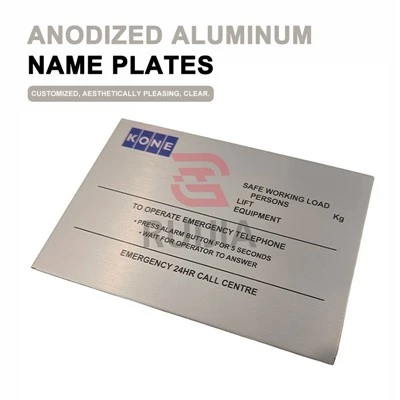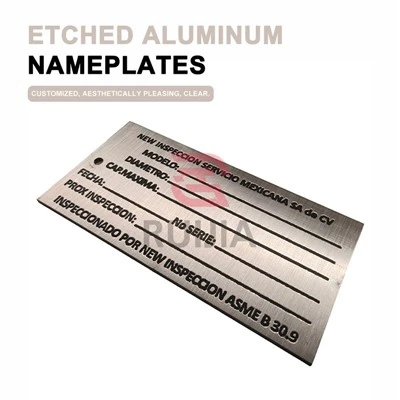


Hangzhou Ruijia Technology Co., Ltd. is one of the most reliable manufacturers and suppliers of automotive aluminum nameplate in China, also supports customized service. Welcome to wholesale bulk discount automotive aluminum nameplate for sale here from our factory. If you have any enquiry about free sample, please feel free to email us.
Automotive Aluminum Nameplates - 5052/6061, Type II Anodized, Etched/Laser-Marked
The service environment sets alloy and thickness first. 5052-H32 in 0.5–0.8 mm suits road-salt exposure with a bend radius; 6061-T6 in 0.8–1.0 mm is specified for clamp load or flatness across a machined surface. Continuous chloride exposure moves the substrate to 304 or 316 stainless. The mounting drawing fixes hole diameter and position, edge break, and brass grommets where steel fasteners bear on aluminum, addressing galvanic wear at design stage.
Type II anodizing is applied before marking. Sealed anodize on 5052 or 6061 typically clears 336 hours of ASTM B117 salt spray, with higher sealing extending beyond 500 hours in internal checks. Etching recesses part numbers and DataMatrix codes by 0.05–0.1 mm; laser marking bleaches the dye layer without cutting the oxide film. DataMatrix symbols are produced to ISO/IEC 15415 grade B with human-readable text. No ink or adhesive-backed print is used. Lots retain material certificates and marking programs, are produced under ISO 9001 with RoHS and REACH declarations, and can be quoted with an IATF-aligned documentation package. The 12-node inspection covers hole position, anodize thickness, and marking legibility; forming accuracy holds at ±0.01 mm.

Specification
| Parameter | Specification |
| Base material | Aluminum 5052-H32 (road-salt exposure, forming); 6061-T6 (clamp load, flatness) |
| Thickness / Size | 0.3–1.5 mm, common 0.5–1.0 mm; custom 10–500 mm, to drawing |
| Surface | Sealed Type II anodizing; matte, gloss, brushed or sandblasted |
| Marking | Etched 0.05–0.1 mm or laser-marked; DataMatrix to ISO/IEC 15415 grade B |
| Corrosion | Sealed anodize typically 336 h ASTM B117; beyond 500 h with higher sealing in internal checks |
| Mounting | 3M 467MP/300LSE adhesive; 3.2/5.6 mm holes for rivet or screw; brass grommets available |
| Compliance | ISO 9001; RoHS and REACH declarations; PPAP/IATF-aligned package quoted at RFQ |
| Inspection | 12-node sequence; hole position, anodize thickness, marking legibility; ±0.01 mm forming accuracy |
| MOQ / Samples | 100 pcs per size; mixed sizes combinable; samples 3–5 working days from approved artwork |
Stainless substrate quoted separately for continuous chloride exposure.
Core Products

Aluminium Nameplates

Stainless Steel Name Plates

Brass & Zinc Alloy Badge

QR Code Barcode Asset Tag

Acrylic & Traffolyte Label

Electroformed Nickel Sticker

Wine & Perfume Bottle Label

ABS Car Badge

Metal Phone Stickers
Base material selection

We cut automotive aluminum nameplates from 5052 or 6061 alloy sheet in 0.3 mm to 1.5 mm thickness. The choice between the two is a forming decision. 5052-H32 offers better corrosion resistance in road-salt and coastal exposure because of its magnesium content, and it forms more readily around curved or recessed mounting surfaces. 6061-T6 brings higher tensile and yield strength where the plate must hold shape under clamping load or serve as a semi-structural bracket face. For tags mounted directly on cast iron or near battery boxes, we quote both alloys and let the drawing tolerances determine the final call. Where chloride exposure is continuous-wheel-arch tags, underbody brackets, marine-adjacent chassis-304 or 316 stainless becomes the more realistic substrate, and we switch the material rather than over-specifying a coating on aluminum.
Surface treatment and corrosion performance
Aluminum automotive nameplates receive Type II anodizing before marking. The oxide layer grows out of the substrate rather than sitting on top of it, which is why an anodized tag does not delaminate when brake fluid or engine oil contacts the surface, or when the part cycles between cold-start and operating temperature. Sealed Type II anodize on 5052 or 6061 typically clears 336 hours of neutral salt spray per ASTM B117 without base-metal corrosion; higher sealing quality pushes the same finish past 500 hours in our internal checks. For under-hood tags that also see UV through the windshield or engine bay opening, the anodized dye layer is evaluated separately-anodize color can shift under long-term UV even when corrosion resistance holds.

Marking that stays on the part

Two marking routes cover automotive identification. Chemical etching recesses characters, OEM part numbers, and DataMatrix codes by removing 0.05 mm to 0.1 mm of aluminum. The recess survives handling, coating buildup, and light abrasion because the information is below the surface plane. Laser marking on anodized aluminum bleaches the dye layer to create contrast without cutting through the oxide film, which keeps the corrosion barrier intact around the characters. Neither method uses ink or adhesive-backed print, so the marking does not peel, fade, or wash off with solvent contact. For tags carrying a DataMatrix ECC200 symbol for automated traceability, the code is produced to grade B verification under ISO/IEC 15415, with human-readable text alongside it so the tag remains identifiable if a scanner is unavailable.
Quality control production line


Mounting interfaces
Three mounting configurations are standard. Pressure-sensitive backing uses 3M 467MP or 300LSE acrylic adhesive for flat, clean metal surfaces; the adhesive system is chosen for shear strength on aluminum and for resistance to oils and fuels rather than for general-purpose bonding. High-vibration locations receive 3.2 mm or 5.6 mm pre-punched holes for rivet or screw fixing, and brass grommets are inserted where the fastener bears directly on aluminum to prevent galvanic wear and hole elongation. A third option combines adhesive with a mechanical fastener for tags that must stay in place while an adjacent component is removed during service. We do not recommend adhesive-only mounting on surfaces that flex or exceed 90°C in continuous operation; the mechanical interface is specified instead.

Customer reviews

Our factory

Production Base and Workshop Configuration

Production Capacity and Equipment Strength

Quality Control and Compliance System
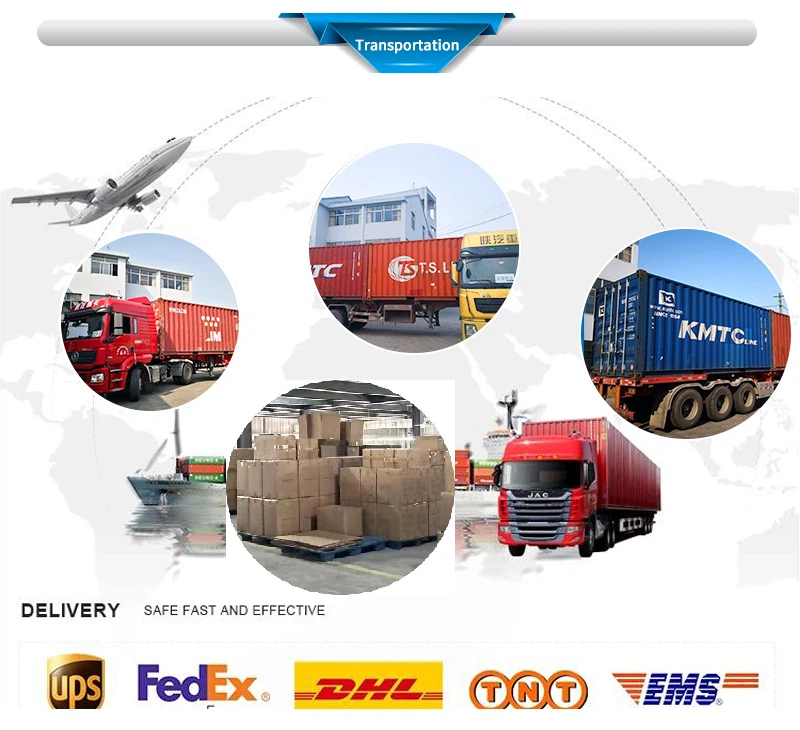
Package & Delivery
Package: Standard export package or Custom
Delivery: By air express, by sea
Exhibition photos


Q: What operating temperature range do these nameplates tolerate, and does anodize color hold at continuous engine-bay heat?
A: The aluminum substrate and sealed Type II anodize are rated for continuous service up to 150°C, with short excursions to 200°C. Above that, adhesive backing is not specified and a mechanical fastener is quoted. Anodize dye stability is checked separately: standard colors hold through 1,000 hours of 85°C / 85% RH aging with ΔE ≤ 3 against the approved sample. Black and dark bronze shift least; red and blue are evaluated per program if the tag sits close to exhaust or turbo components.
Q: How does the marking hold up against brake fluid, engine oil, coolant and workshop solvents?
A: Etched characters are recessed 0.05–0.1 mm below the anodize surface and survive brake fluid, DOT 4, engine oil and coolant contact without loss of legibility. Laser-marked characters bleach the dye layer within the oxide film; the film remains intact, so solvent wipe-down does not remove the marking. We test against the fluids named in your service specification-send the list at RFQ and the resistance data is included in the PPAP file. Adhesive-backed print and ink are not used on any automotive tag we produce.
Q: What dimensional tolerances and flatness can you hold on a 0.8 mm 5052 tag with pre-punched holes?
A: Length and width hold to ±0.1 mm, hole position to ±0.05 mm, and hole diameter to ±0.03 mm on stamped and etched parts. Flatness on 0.8 mm 5052 is held to 0.2 mm over a 100 mm length after anodizing; tighter flatness is quoted with a sizing operation. Forming accuracy on core equipment is ±0.01 mm where the drawing requires it. First-article inspection reports record hole position, anodize thickness and marking legibility against the drawing.
Q: How do you control anodize color from lot to lot, and what happens if a batch falls outside the approved sample?
A: Each lot is matched to the approved sample under D65 lighting, with ΔE ≤ 1.5 as the acceptance limit for standard colors. Dye bath concentration, temperature and immersion time are logged per batch, and the anodize line runs a coupon alongside production for color and coating-weight checks. A lot outside tolerance is held before packing, reworked where the dye layer allows, or re-anodized; it does not ship against the part number. Color approval samples are retained for the life of the program.
Q: What is the production lead time for a 5,000-piece order, and how is capacity allocated across the four product lines?
A: A 5,000-piece aluminum nameplate order runs 15–20 working days after artwork and first-article approval, assuming standard alloy and finish. The 35,000㎡ facility runs 86 automated machines across five workshops, with nameplate work scheduled separately from badge, label and metal craft lines so capacity is not shared. Monthly shipment averages 1.5 million pieces across product categories. For programs with fixed delivery windows, JIT and batch delivery are supported from the 8,000㎡ warehouse; the production slot is confirmed at PO rather than at quotation.
Contact us for more information.
Hot Tags: automotive aluminum nameplate, China automotive aluminum nameplate manufacturers, suppliers, factory